Fearnoch by Jim McEwen.
I am always in search of Canlit. When I go into bookstores or when I browse for books online, one thing I do is always search for Canadian literature. One of my journeys down these rabbit holes led me to @breakwaterbooks and Jim McEwen’s Fearnoch, and oh what a gorgeous journey this book has taken me on.
The novel follows four characters who live in or are from the rural farming town of Fearnoch, Ontario: John, Mikey, Kirby, and Anna. All four had journeys that I wanted to follow from beginning to end — I did not find myself wanting to skip any sections to get to the next character faster. Mikey’s solitary journey of reading about the world, even as he spent his days and weeks deeply embedded in his town and with his people, until he meets the new girl who can play hockey. Kirby’s childhood and adulthood as inextricably entwined from the town that made him the man that he is, and the journey he and his wife are on. Anna’s distance as she makes her way in Montreal and writes her book, and her mentorship of Ebenezer.
I did, however, find myself more than a little drawn to the threaded story of John and his father, fully invested in how McEwen wrote these characters to life as six generations of a farming family on the same 100 acres of land. I am one generation removed from farming (hello, globalization and labour outmigration), and perhaps this is why I was deeply invested in the stories of a town that is perhaps unwantedly changing due to the tendrils of gentrification snaking in.
I could see the landscape that he describes, feel the fences under my fingers, see the creek and the tadpoles and the small-town meeting halls. I’m not from a small town in Ontario, but I did spend a lot of time at my grandparents’ farm growing up, back in the provinces of Western Visayas in the Philippines. It was vivid. It continues to be vivid.
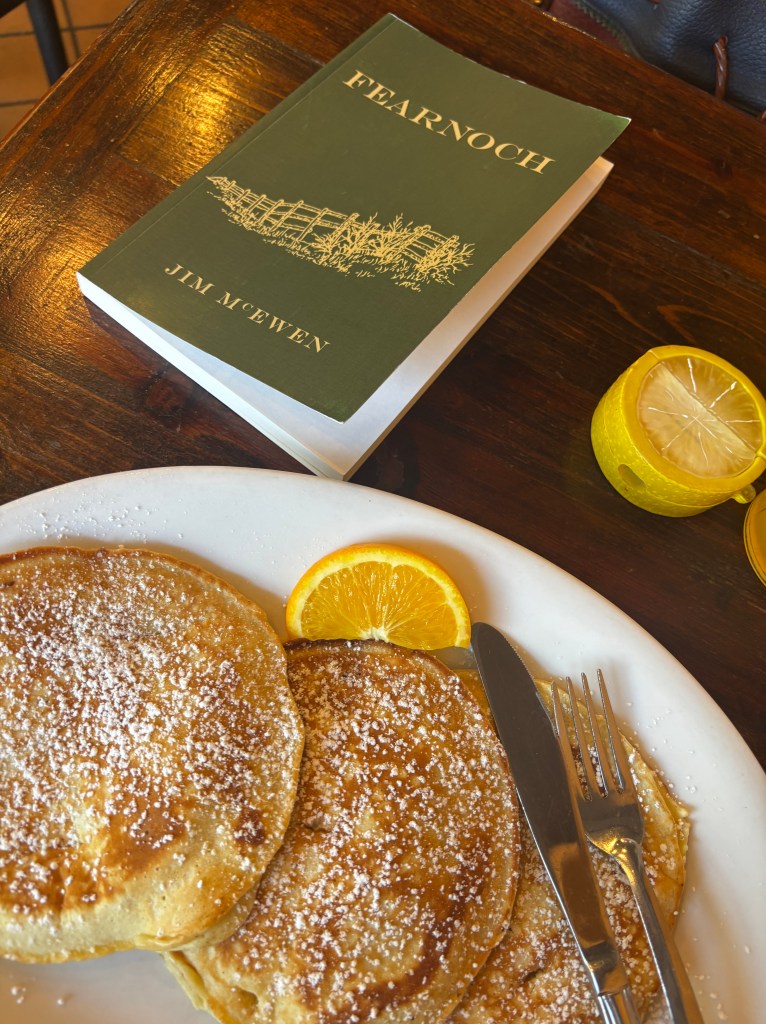
On a week that I had a free morning, I took myself out on a solo date to a bistro, where I cried over the last third of the book while eating a delicious pile of pancakes dusted with powdered sugar. I felt such despair when the disaster hits the town, and gut-wrenching sadness at the desperate ways in which the characters made their ways (back) to each other during the catastrophes and in the aftermath. As soon as I finished the book, I immediately started dipping back into the novel, dog-earing pages and underlining every powerful paragraph that hurt me to read. The passage describing John running with his son through the tornadoes struck me so hard that I read it out loud to my husband on the couch as we settled in for the evening.
What powerful writing, what a beautiful addition to my shelf of Canadian literature. 5 stars — I highly recommend picking up this book if you want to open a door into rural Ontario and walk the streets with characters that feel so real you can almost feel them brushing past you as you walk into the convenience store.
 Dani Magsumbol